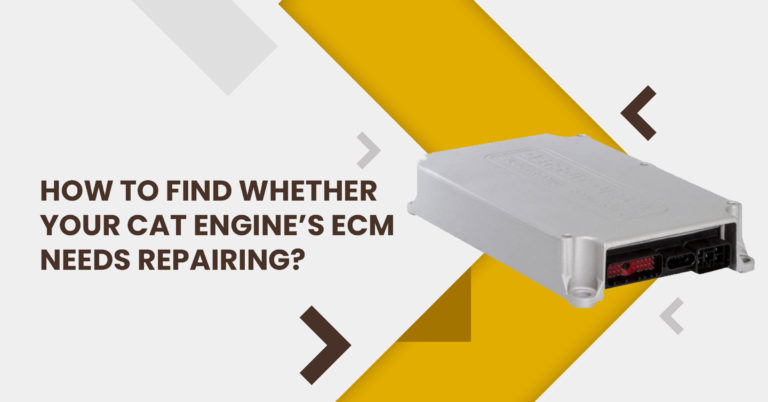
Cat 3126 ECM repair keeps one of the most common medium-duty diesel engines on the road running. The 3126 powered school buses, delivery trucks, motorhomes and vocational trucks for years, and many of those engines still work hard today.
This guide covers the 3126B and 3126E ECMs, the serial prefixes and part numbers to look for, the most common faults, how ECM problems relate to the 3126’s injection system, and when repair or replacement makes sense.
In this guide
About the Cat 3126 ECM
The 3126 is a 7.2-liter inline six that Caterpillar built from the late 1990s into the early 2000s. It uses hydraulically actuated electronic unit injectors (HEUI): engine oil under high pressure drives the injectors, and the ECM controls when and how long each injector fires.
That makes the Cat 3126 ECM the heart of the fuel system. If the ECM cannot drive an injector, that cylinder goes dead. If it cannot control injection pressure, the engine may not start at all.
Two main versions exist: the 3126B and the later 3126E. Each uses its own ECM, and each comes in several part numbers depending on the engine arrangement.
3126 serial prefixes and part numbers
The engine serial prefix (the first three characters of the serial number) tells you which ECM fits. These are the units on our price list (November 2026):
| Engine | Serial prefix | ECM part numbers |
|---|---|---|
| 3126B | 7AS | 149-6989-01, 157-3708-00 |
| 3126B | 8YL | 162-7584-00 to -03 |
| 3126E | CKM | 192-7896-01 to -03, 179-4899-02 |
| 3126E | HEP | 206-2700-00 to -02 |
Always check the label on your own unit. Part numbers can have interchanges, and our ECM part number guide explains how to read them. Find the prefix on the engine data plate using our page on finding your engine serial number.
Common Cat 3126 ECM faults
- Dead cylinder: a failed injector driver circuit in the ECM leaves one cylinder without fuel.
- Crank, no start: the ECM powers up but never fires the injectors.
- Intermittent stalling: cracked solder joints open up when the engine is hot or vibrating.
- No communication: the service tool cannot connect to the 3126 ECM.
- Water damage: corrosion in the connectors or on the board, common on buses and trucks that are pressure-washed.
Many of these units are now over 20 years old, so age-related faults are normal. That is good news in one way: these are exactly the faults a repair fixes.
3126 HEUI and ECM-related problems
On a HEUI engine, some problems look like an ECM failure but start in the hydraulic system. Low oil level, worn high-pressure oil pump, a faulty injection pressure regulator or a leaking oil rail can all cause hard starting and low power.
Before you send the ECM for Cat 3126 ECM repair, check oil level and condition, injection actuation pressure with a service tool, and the injector harness under the valve cover. If pressure is normal and the harness is good, the ECM becomes the prime suspect.
Cat 3126 ECM repair vs replacement
Repair is usually the better choice for a 3126 ECM:
- It keeps your original software and settings, so there is no programming to arrange.
- It avoids the risk of a used unit with an unknown history or the wrong part number.
- It costs less than a remanufactured replacement.
Replacement makes sense when the board is burned or badly corroded. Our remanufactured 3126 ECMs ship pre-programmed to your engine serial number. See the 3126 ECMs on our site.
Cat 3126 ECM repair cost
On our price list (November 2026), Cat 3126 ECM repair costs $619.99 for 70-pin units and $699.99 for 40-pin units, both with a 1-year warranty. Remanufactured 3126 replacements run from $1,499 to $2,499 plus a core charge.
If our bench test finds nothing wrong, you pay only the $149 diagnostic fee. Most repairs are completed within 1 to 3 days of arrival.
How to send your 3126 ECM
- Disconnect the batteries, label the connectors and remove the ECM.
- Note the engine serial number, ECM part number and any fault codes.
- Pack the module in a sturdy box with padding, connectors covered.
- Ship it with your contact details to our Fort Worth, Texas shop.
The full process is in our guide to Caterpillar ECM repair.
3126 engines in buses, RVs and vocational trucks
Many 3126 engines work in school buses, motorhomes and vocational trucks rather than long-haul tractors. These vehicles often sit for long periods, get washed often, and run short trips that never fully dry out the engine bay.
That makes water in the ECM connectors and corroded pins more common. When you remove the module, look for green or white deposits on the pins and a damaged seal around each connector. If you find corrosion, clean the harness side too, or the new problem will start again.
Frequently asked questions
Where is the ECM on a Cat 3126?
On the side of the engine block, held with bolts and rubber isolators.
Is the 3126B ECM the same as the 3126E ECM?
No. They use different part numbers and software. Match your unit by part number and serial prefix.
Can a bad ECM cause a dead cylinder on a 3126?
Yes. A failed injector driver circuit is a common Cat 3126 ECM fault. Check the injector and harness first to be sure.
Does a repaired 3126 ECM need programming?
No, in most cases. It goes back on the engine plug and play.
Keep your 3126 running
Call 726-999-0231 or contact us with your serial prefix and ECM part number. Caterpillar’s own engine information is at cat.com.