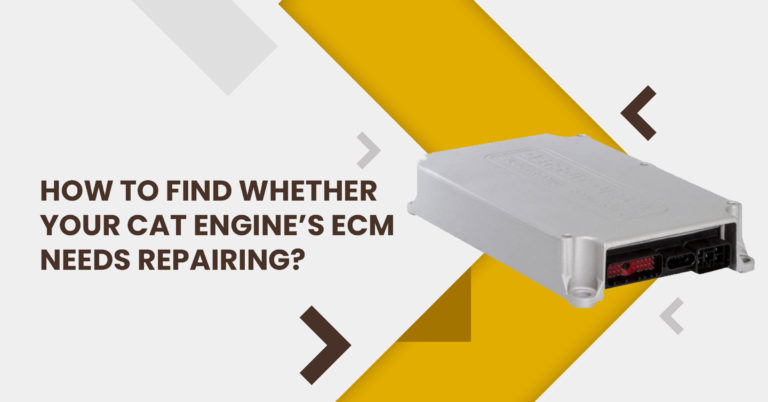
Truck ECM diagnosis should always come before an ECM repair or replacement. A large share of the “bad ECMs” sent to repair shops test perfectly good, because the real problem was a battery, a ground, a wire or a sensor.
This guide explains how to test an ECM on a heavy truck in 8 practical steps, how to read fault codes, when a bench test is needed and what the results tell you.
In this guide
Why truck ECM diagnosis comes first
The engine computer depends on clean power, a solid ground, good wiring and honest sensor signals. If any of those fail, the engine can stall, lose power or refuse to start, and the ECM gets the blame.
A proper diagnosis saves money twice: you avoid buying a module you did not need, and you fix the real cause so a new or repaired ECM is not damaged by the same fault.
8 tests to diagnose an ECM
You need a good digital multimeter, the wiring diagram for your engine and, ideally, a service tool that can talk to the engine.
- Battery test: load-test each battery. Check that voltage stays above about 9.5 volts while cranking.
- Cable and ground check: clean and tighten battery cables, engine ground and frame ground. Look for corrosion inside the insulation.
- Voltage drop test: measure voltage drop across the main ground and power cables while cranking. A high drop means a bad cable or connection.
- Power at the ECM: back-probe the ECM connector and confirm battery voltage on the power pins and a good ground with the key on.
- Key switch input: confirm the ECM sees the ignition signal.
- Connector inspection: unplug the ECM connectors and look for water, corrosion, bent or pushed-back pins.
- Sensor supply check: measure the 5-volt sensor supply. A shorted sensor can pull it down and make many sensors read wrong at once.
- Data link test: if the service tool cannot connect, check the diagnostic connector, data link wiring and the other modules on the network.
Most trucks use the SAE J1939 data link. If one faulty module drags the network down, no module may answer.
Reading and understanding fault codes
Fault codes tell you which circuit the ECM thinks is wrong, not always which part has failed. A code for a sensor circuit can mean the sensor, the wire, the connector or the ECM input.
- Note both active and logged codes, with the number of occurrences.
- Look for patterns: many codes at once often point to a shared power, ground or 5-volt supply.
- Do not clear codes until you have written them down.
- After a repair, clear the codes and road-test to see what returns.
Our page on bad ECM symptoms links common symptoms to their most likely causes.
When a bench test is needed
If power, ground, wiring and sensors all check out and the problem remains, the ECM itself is the next suspect. On the truck, it is hard to prove an internal fault. A bench test settles it.
On a test bench, the ECM is powered and connected to simulated sensors and injector loads. Technicians can see whether each output works, whether the module communicates, and whether faults appear with heat or vibration.
We bench-test every ECM we receive. If it tests good, you pay only the $149 diagnostic fee and we ship it back with our findings.
What the results tell you
| Result | Likely meaning | Next step |
|---|---|---|
| Low voltage while cranking | Batteries, cables or starter | Fix the charging and starting system |
| No power or ground at ECM | Fuse, breaker or wiring | Repair the circuit |
| Many sensor codes at once | 5-volt supply or shared ground | Find the shorted sensor or wire |
| Good power, no communication | ECM or data link | Test other modules, then the ECM |
| All checks pass, fault remains | Internal ECM fault | Bench test and repair |
If the ECM is at fault, see our guides to diesel ECM repair and Caterpillar ECM repair.
Tools for truck ECM diagnosis
- A quality digital multimeter with back-probe pins.
- A battery load tester or conductance tester.
- The engine wiring diagram and connector pin-out.
- A service tool or scanner that reads heavy-duty fault codes.
- A test light for quick power checks (never on sensor circuits).
Frequently asked questions
How do you test an ECM on a truck?
Check batteries, cables, grounds and power at the ECM connector, inspect the connectors, test the sensor supply and data link, then bench-test the ECM if everything else is good.
Can a bad ground mimic a bad ECM?
Yes. A poor ground causes random stalls, false codes and communication loss that look exactly like an ECM failure.
Do I need a scan tool for ECM testing?
It helps a lot, but many key checks need only a multimeter and the wiring diagram.
How much does ECM diagnosis cost?
Our bench diagnosis is $149 if the ECM tests good. If it needs repair, the diagnosis is part of the repair job.
Need a second opinion?
Call 726-999-0231 or contact us with your engine model, fault codes and the readings you took. Our Fort Worth team will help you decide whether to diagnose an ECM further or send it in.