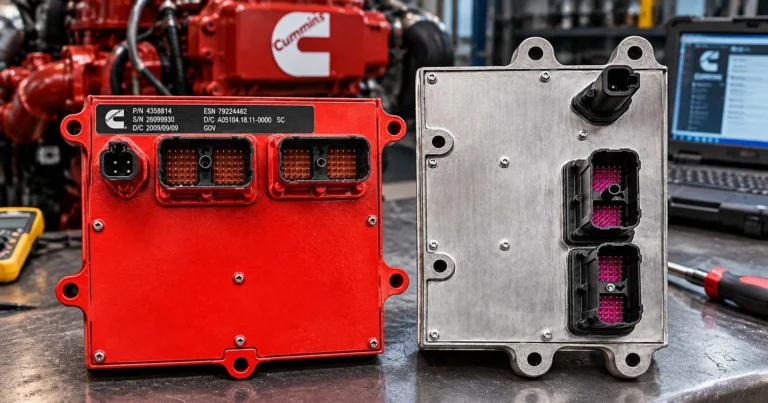
Cat ECM problems are some of the most misdiagnosed faults on a Caterpillar truck engine. A weak battery, a corroded ground or a damaged wire can make a perfectly good engine computer look dead.
Before you pay for a repair or replacement, work through the 9 checks below. They catch most false failures, explain what to do when the module will not communicate, and show the signs that really do point to the ECM.
In this guide
Common Cat ECM problems
Drivers and mechanics usually call us with one of these complaints:
- The engine cranks but will not start.
- The engine stalls or cuts out, then restarts.
- The truck has low power or runs derated.
- One cylinder is dead or the engine misfires.
- The service tool cannot connect to the engine.
- Many unrelated fault codes appear at once.
Each of these can be caused by the ECM, but each also has simpler causes. Caterpillar ECM problems are often wiring and power problems in disguise.
9 checks before you blame the ECM
- Battery state: load-test the batteries. Low voltage while cranking can stop the ECM from powering up properly.
- Battery cables: clean and tighten both ends. Look for green corrosion inside the insulation.
- Engine and frame grounds: a loose ground causes erratic faults that come and go.
- Power at the ECM: measure unswitched battery power and ground at the ECM connector itself.
- Key switch input: confirm the ECM sees the key-on signal.
- Connectors: unplug both ECM connectors and check for water, bent or pushed-back pins and broken locks.
- Fuses and breakers: check the ECM power fuse or breaker and its holder.
- Injector harness: on a dead cylinder, check the harness under the valve cover before blaming the injector driver.
- Sensor faults: a shorted sensor can pull down the 5-volt supply and make many sensors read wrong at once.
Our guide to truck ECM diagnosis explains how to run each test with a multimeter.
When the Cat ECM won’t communicate
Cat ECM no communication is one of the most common calls we get. Before blaming the module, check:
- That the ECM has power and ground with the key on.
- The diagnostic connector in the cab and its wiring.
- The data link wires for chafing or shorts to ground.
- Other modules on the data link: a faulty dash or transmission module can drag the whole network down.
Most late-model trucks use the SAE J1939 data link. If other modules talk and the ECM has good power, ground and wiring but still will not answer, the module itself is the likely cause.
Signs it really is the ECM
After the checks above, these signs point to a real failure:
- Good power, ground and wiring, but no communication.
- A dead cylinder that follows the ECM driver, not the injector or harness.
- Faults that change when you tap or warm the module.
- Visible damage, burn marks, or water inside the connectors.
- Settings or trip data that reset by themselves.
Our page on bad ECM symptoms lists more signs and their likely causes.
Next steps if the ECM is at fault
If the checks point to the module, you have two options:
- Repair: our Caterpillar ECM repair costs $619.99 for 70-pin units and $699.99 for 40-pin units, with a 1-year warranty. Your programming stays in place. See Caterpillar ECM repair.
- Replace: a remanufactured unit pre-programmed to your engine serial number. See Caterpillar ECM replacement.
Not sure? Send us the ECM. If our bench test finds nothing wrong, you only pay the $149 diagnostic fee.
Preventing Cat ECM problems
Many of the faults above start with something simple. Keep battery cables and grounds clean and tight, keep pressure-washer spray away from the connectors, and always disconnect the batteries before welding on the truck or trailer.
Use a proper booster when jump-starting, and make sure the ECM’s rubber isolators are in place. Our article on ECM maintenance covers these habits in detail.
What to tell us when you call
The more we know, the faster we can help. Have this ready:
- The engine model and full serial number from the data plate.
- The ECM part number from the label.
- Active and logged fault codes, with how often each one occurred.
- What you have already checked and the voltage readings you measured.
- When the problem started, and whether the truck was welded on, jump-started or washed just before.
Frequently asked questions
What are the most common Cat ECM problems?
No start, stalling, low power, a dead cylinder, no communication and many unrelated codes. Many are caused by power, ground or wiring faults rather than the ECM itself.
Can a bad battery cause Cat ECM problems?
Yes. Low or unstable voltage can make the ECM reset, lose communication or fail to start the engine.
Why does my Cat ECM have no communication?
Check power and ground at the ECM, the diagnostic connector, the data link wiring and other modules on the network before blaming the ECM.
Can you test my ECM before I pay for a repair?
Yes. We bench-test every unit. If it tests good, you pay only the $149 diagnostic fee.
Still stuck? Call us
Our Fort Worth team helps mechanics and owners work through Caterpillar ECM problems every day. Call 726-999-0231 or contact us with your engine serial number and fault codes.