Diesel ECM technology changed the trucking industry more than almost any other development of the last 40 years. Engines went from mechanical injection pumps and governors to computers that control every injection event, protect the engine and record how the truck is driven.
This guide looks at life before the electronic diesel engine, 4 powerful changes in diesel ECM technology, what a modern truck engine computer handles, and how all of this affects repairs on older and newer trucks.
In this guide
Before electronic engines
Until the late 1980s, heavy truck diesels were controlled mechanically. A fuel injection pump or mechanical unit injectors, driven by the engine, decided how much fuel each cylinder got. A mechanical governor limited engine speed. Timing was set by gears and adjusted by hand.
These engines were simple and tough, but they could not adjust precisely to load, altitude or temperature, and they could not meet the emissions rules that were coming.
4 powerful changes in diesel ECM technology
1. The first electronic diesel engines (late 1980s to early 1990s)
Detroit Diesel’s DDEC system on the Series 60, Caterpillar’s early electronic engines such as the 3176, and Cummins Celect on the N14, M11 and L10 brought electronic control of fuel and timing to heavy trucks. The ECM also added road speed limiting, cruise control and basic fault codes.
2. More memory and data (mid to late 1990s)
Generations such as DDEC IV, Cummins Celect Plus and Caterpillar’s 3406E-era ECMs added detailed trip data, engine protection, programmable customer parameters and better diagnostics. Fleets could now see idle time, fuel economy and driver habits.
3. Emissions control (2000s)
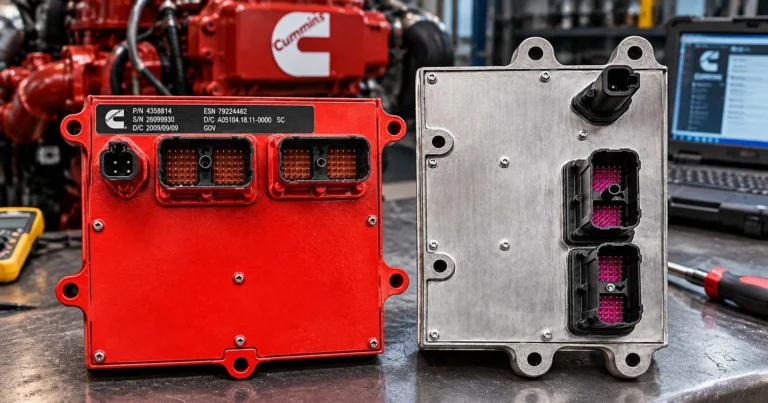
Tighter emissions rules brought exhaust gas recirculation, variable geometry turbos and, from 2007, diesel particulate filters. The ECM took over control of all of them. Engines like the Cummins ISX with CM870 and CM871 ECMs, Caterpillar ACERT engines and DDEC V show this era.
4. Networked trucks (2010 onward)
Selective catalytic reduction, more sensors and more modules turned the truck into a network. The ECM shares data with the transmission, brakes and dash over the SAE J1939 network, and telematics send engine data to fleet offices in real time.
What a modern ECM handles
- Injection quantity, timing and multiple injection events per cycle.
- Turbo boost through the variable geometry turbo actuator.
- EGR flow and aftertreatment such as the DPF and SCR.
- Engine protection, derates and shutdowns.
- Cruise, road speed limits, idle management and the engine brake.
- Trip data, fault codes and communication with other modules.
For a plain-English overview, read what an engine control module is.
How the technology affects repairs
With more diesel ECM technology on the truck, more things can fail, but also more information to find faults. Modern diagnosis starts with fault codes and data, not just listening to the engine.
It also means that a replacement ECM must be programmed with the right software and settings. On older engines, a repair that keeps the original software is often easier than finding a matching, correctly programmed replacement.
Keeping older electronic engines running
Many first and second generation electronic engines are still working: Celect and Celect Plus N14s, DDEC III and IV Series 60s, 3406E and early C15 Caterpillars. Their ECMs are now 25 to 35 years old, and cracked solder joints, worn connector seals and tired power components are common.
We repair every generation of truck engine computer, and older ECMs every day. On our price list (November 2026) Cummins Celect and Detroit DDEC repairs cost $499.99 and Caterpillar repairs $619.99 to $699.99, each with a 1-year warranty. See diesel ECM repair.
Frequently asked questions
When did trucks start using ECMs?
Heavy truck diesels began using electronic engine control in the late 1980s and early 1990s.
What was the first electronic truck diesel?
Detroit Diesel’s DDEC-equipped engines, including the Series 60, were among the first widely used electronic heavy truck diesels.
Can older ECMs still be repaired?
Yes. Many Celect, DDEC III and IV and early Caterpillar ECMs can be repaired at component level.
Why do modern trucks need programming after an ECM swap?
Because the ECM holds software and settings matched to one engine and one truck.
Keep your engine computer running
Call 726-999-0231 or contact us about your ECM, old or new. Our Fort Worth, Texas team works on every generation of diesel engine computer.